
Most overseas trips from Australia need a travel adapter, but working out which one can be surprisingly confusing. Countries use different plug shapes, some run on very different voltages, and the adapter aisle is full of options that look almost identical. Pack the wrong one and you can find yourself in a hotel room with a flat phone and nowhere to plug it in.
The good news is that it’s simpler than it looks. Four adapter styles cover nearly every destination Australians travel to, and a few places, like New Zealand and Fiji, use the same plug as home. Most of the chargers you already own will also work anywhere in the world with nothing more than the right adapter.
- No Adapter Needed: Some destinations like New Zealand and Fiji use the exact same Type I plug as Australia, meaning you don’t need an adapter at all and can save money.
- Adapter vs. Converter: Most modern devices are dual-voltage (100–240V) and just need a plug adapter, while single-voltage tools (230V Australian hair straighteners) require a step-down converter to work in 110V regions.
- Tricky destination: Certain places differ in Europe, so a generic adapter may not fit – including Italy and Switzerland.
- GaN multi-port travel adapters are recommended: GaN chargers with multiple USB-C ports are the modern, efficient solution that handles MacBook, iPhone, and other devices from one wall point.
Plug Types and Voltage by Country
As a baseline, Australia uses Type I plugs, 230V voltage, and a 50Hz frequency. Anywhere else in the world with 220 to 240V will work exactly like home once you have the right adapter. Countries marked for a converter run at 100 to 127V, which affects some Australian devices.
| Destination Country | Plug Type(s) | Standard Voltage | Do You Need an Adapter? | Crucial Technical “Gotcha” to Publish |
|---|---|---|---|---|
| Indonesia (Bali) | C & F | 230V | YES | Outlets are often deeply recessed into the wall. Bulky rectangular universal adapters can fail to seat properly; a slim round-base Type C or F adapter is safer. |
| New Zealand | I | 230V | NO | Completely seamless. Plugs and voltage match Australia perfectly. |
| Japan | A | 100V | YES | Lowest voltage in the world. Japanese Type A sockets almost never have a third grounding hole. If your adapter has three prongs, it won’t fit. Australian hair dryers/straighteners will barely heat up here. |
| United States | A & B | 120V | YES | Type A is two flat pins; Type B includes a round grounding pin. Make sure your adapter handles both. Single-voltage Australian appliances need a bulky step-down voltage converter. |
| United Kingdom | G | 230V | YES | UK Type G outlets feature individual manual power switches next to the socket. If your device isn’t charging, check that the wall switch is toggled “on.” |
| Thailand | A, B, C, F, O | 220V | YES | Uses universal hybrid sockets that accept both flat and round pins. Type O is unique to Thailand. Bring a universal adapter to handle structural variances between older and newer hotels. |
| China | A, C, I | 220V | SOMETIMES | China utilizes Type I (same as Australia), but the pins are slightly thinner and installed upside down relative to Aussie outlets. While flat two-pin Aussie plugs often slide right in, three-pronged plugs can require a local adapter. |
| Singapore | G | 230V | YES | Identical setup to the UK. Sockets feature automated safety shutters; the top grounding pin must be engaged first to open the bottom active/neutral holes. |
| Fiji | I | 240V | NO | No adapter required. Fiji uses standard Australian-style flat three-pin configurations. |
| Italy | C, F, L | 230V | YES | Italy’s traditional Type L plug has three thin round pins in a straight line. Modern hotels use hybrid Type C/F sockets, but historic buildings or boutique stays still rely on old Type L outlets where standard European adapters do not fit. |
| France | C & E | 230V | YES | France uses a Type E socket which has a distinctive male grounding pin protruding directly out of the wall socket. A generic European Type C plug fits, but your adapter must have a specific alignment hole to accept the wall’s grounding pin. |
| Vietnam | A, C, G | 220V | YES | Sockets are incredibly varied. You might find US Type A in the south, European Type C in the north, and UK Type G in luxury hotels. A universal multi-adapter is absolutely mandatory here. |
| Malaysia | G | 240V | YES | Exactly like Singapore and the UK. Voltage and cycles match Australia perfectly. |
| Canada | A & B | 120V | YES | Identical infrastructure to the United States. Dual-voltage devices charge normally, but appliances with heating elements require a converter. |
| Germany | C & F | 230V | YES | Uses standard German “Schuko” Type F sockets featuring side grounding clips rather than pin holes. |
| Greece | C & F | 230V | YES | Uses standard European round-pin infrastructure. Islands sometimes have older, looser wall sockets where heavy universal adapters can sag and slip out of the wall. |
| Spain | C & F | 230V | YES | Standard European round-pin requirements. |
| Hong Kong | G | 220V | YES | Follows the UK Type G footprint. |
| India | C, D, M | 230V | YES | The most unstable/variable country on the list. Type D features three large round pins. Type M is an even larger variant often reserved for heavy climate control units. Power surges are common; advise users to pack an adapter with an integrated surge protector. |
| Philippines | A, B, C | 220V | YES | Primarily uses flat US-style Type A/B outlets but runs on a European 220V loop. Plugging a single-voltage US appliance here destroys it, but Australian dual-voltage devices work flawlessly with a simple flat-pin shape adapter. |
The Four Adapters Australians Actually Need
You don’t need a different adapter for every country. Most destinations fall into one of four groups, and the adapter names below match how Australian stores label them.
Europe adapter (two round pins)
Covers: Bali, France, Germany, Greece, Italy, Portugal, Spain, South Korea, Thailand, Vietnam, Cambodia and most of India.
UK adapter (three rectangular pins)
Covers: the UK, Ireland, Singapore, Malaysia, Hong Kong and most hotels in Sri Lanka.
USA adapter (two flat pins)
Covers: the USA, Canada, Mexico, Japan and the Philippines. These countries also run on lower voltage, so check whether your devices need a converter.
No adapter needed
Covers: New Zealand, Fiji and most Pacific islands. China also uses a similar three-pin socket, though an adapter is handy as backup there.
Choosing a travel adapter
If you travel more than once a year or visit several countries per trip, buy one good universal adapter with USB-C. If you only ever go to one place, a cheap single-country adapter does the job.
| Type | Best for | Pros | Cons |
|---|---|---|---|
| Single-country adapter | One-off trips to one region | Cheap, small, simple | Useless on the next trip elsewhere |
| Universal adapter (sliding pins) | Multi-country trips, frequent travellers | Covers 150+ countries in one unit | Bulkier; some wobble in loose sockets |
| Universal adapter with USB-A/USB-C | Charging several devices at once | Fewer bricks to pack | Cheap ones have weak USB output |
| Universal adapter with GaN fast charger | Laptop users | Can replace your laptop charger | Pricier |
| Australian power board + one adapter | Families, groups, hotel rooms short on sockets | Powers 3 to 6 devices from one socket | Banned on many cruise ships if surge-protected |
Where to Buy My Travel Adapter
Reader Disclosure: This guide is completely free to read. When you buy a travel adapter through the links on this page, we may earn a small affiliate commission at no extra cost to you.
Amazon is your best option for cost-effective adapters. Shopping at Officeworks or JB Hi-Fi will likely cost your far more unless you can leverage a price match.
Look for GaN multi-port travel adapters if you’re doing multiple countries, as these travel adapters come with a built-in fast charger that uses gallium nitride (GaN) instead of silicon. You’ll get multiple high-speed USB-C ports allowing you to charge your MacBook, iPhone, and Kindle simultaneously out of one wall point without needing to pack independent power bricks
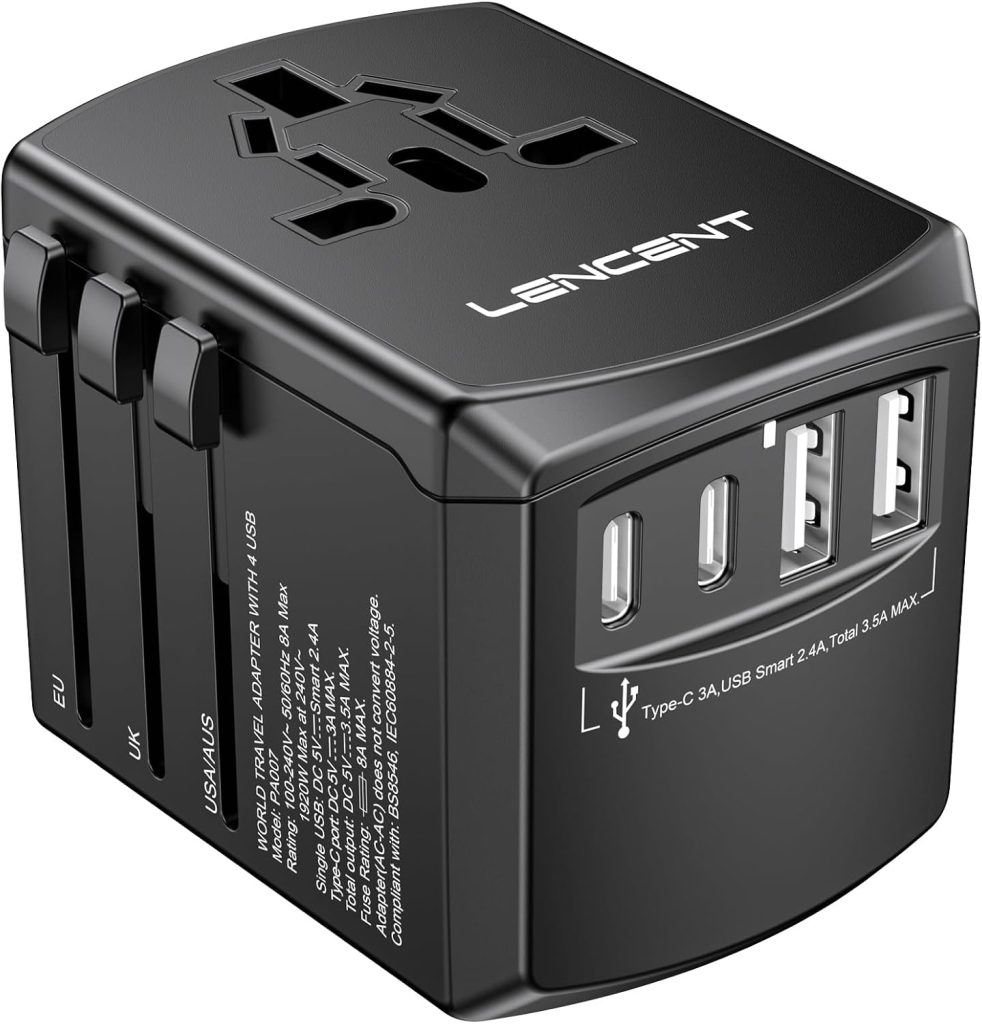
Our pick of travel adapters is the LENCENT Universal Travel Power Adapter, which is designed with 4 integrated plugs that fit 200+ countries and regions worldwide. Type C Plug: France, Germany, Italy, Spain, Iceland, Greece; Type G plug: UK, Ireland, Dubai, Saudi Arabia, Hong Kong, Singapore; Type A Plug: USA, Japan, Canada, Mexico, Thailand, Vietnam; Type I plug (functioned by twisting two prongs of the US plug outwards): China, Australia, New Zealand, Argentina AND 2 USB-C port & 2 USB-A ports(5V/3.5A, 17.5W Max) and a universal AC outlet (240V/8A, 1920W Max).
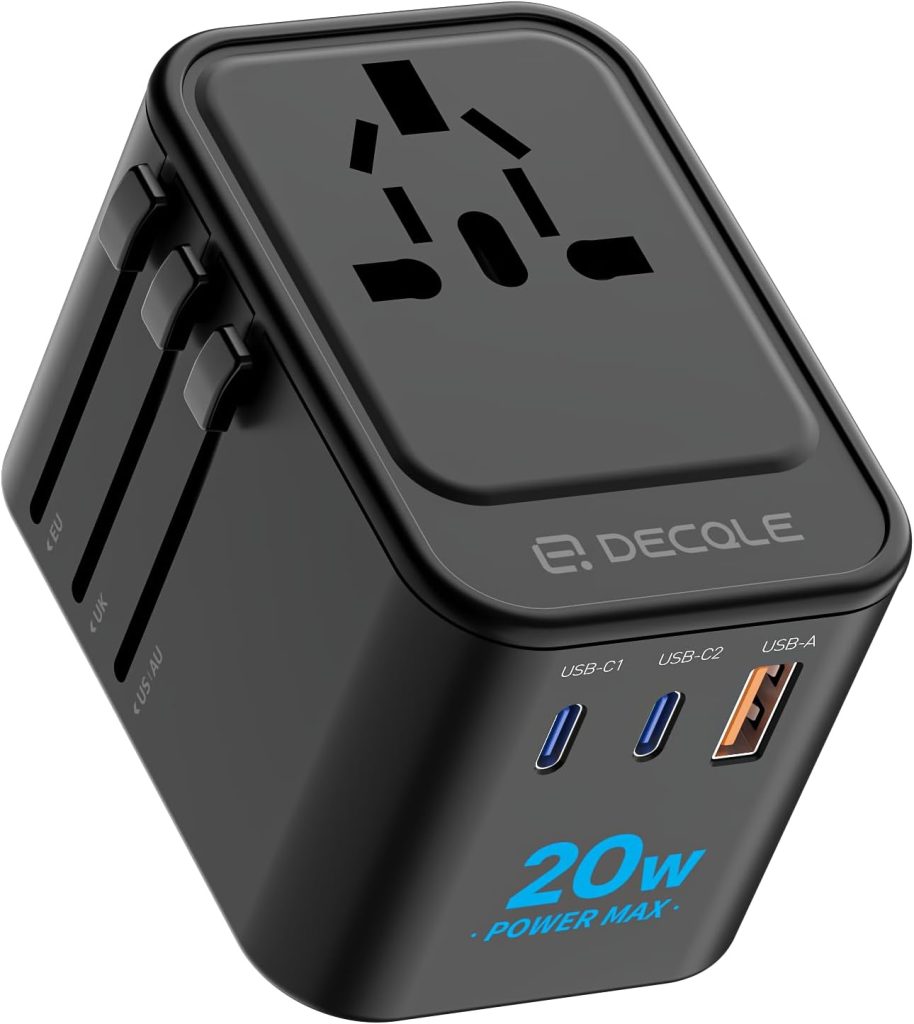
Decqle Universal Travel Adapter, 2 USB-C & 1 USB-A – Designed with 4 interchangeable plugs which meet international plug standard: 1.Type C(most of the Europe) 2.Type G(such as UK, Ireland, Singapore) 3.Type A(such as America, Canada, Mexico) 4.Type I(such as China, Australia, New Zealand). It can cover 224+ countries plug standards.
Travel Adapters for Bali
While your standard European round-pin adapter will work perfectly fine with the electrical current in Bali, the physical design of the wall outlets can cause major headaches.
Most power points in Balinese hotels and villas are deeply recessed into a circular crater in the wall.
- The Problem: If you bring a bulky, wide, square “all-in-one universal adapter,” the body of the adapter will hit the wall before the pins can seat deeply into the live holes. It will either fall out constantly or fail to pass power entirely.
- The Solution: Buy a dedicated, slim, round-base Type E/F (Schuko) adapter or a Type C adapter. These have a cylindrical body that slides perfectly into the recessed wall sockets.
Travel Adapters for USA
The United States operates on roughly half the voltage of Australia. While almost all modern smartphones, laptops, and camera chargers are “dual-voltage” (check the tiny print on the brick for “INPUT: 100-240V”, anything with a heating element will underperform drastically.
- Hair Straighteners & Dryers: If your Australian hair straightener is single-voltage (230V only), do not bring it to the US. It will not blow up, but it will only heat up to a fraction of its normal temperature, rendering it completely useless. You would need a heavy, expensive step-down voltage transformer to use it. Buy a cheap dual-voltage version or a local US appliance instead.
- Type A vs. Type B: Type A plugs have two flat parallel pins. Type B has the same two flat pins plus a round grounding prong at the bottom. Make sure your adapter has a Type A layout so it can fit into any American wall socket – some older hotels do not have the third grounding hole.
Travel Adapters for Japan
While Japan uses a plug that looks identical to the US Type A plug, their infrastructure has a critical difference that catches Australians off guard.
- No Grounding Holes: The vast majority of wall outlets in Japanese hotels, cafes, and bullet trains only have two slots. They completely lack the third, round grounding hole found in US Type B outlets. If you buy a generic “US/Japan” travel adapter that features a third grounding pin, it will not physically fit into a Japanese wall point. Ensure your adapter has strictly two flat pins.
- Extreme Low Voltage: At just 100V, charging powerbanks or laptops can take slightly longer than it does at home. Just like the US, single-voltage high-draw Australian appliances (like curling irons or kettles) will fail to work properly here. Stick strictly to dual-voltage electronics.
Travel power packing checklist
Run through this the week before you fly.
Adapter or converter? What voltage means for your devices
An adapter only changes the shape of the plug. A converter changes the electricity itself. Most Australians only ever need an adapter, because nearly everything we pack is built to handle a wide range of voltages.
The quick check is the small print on your charger or power brick. If it says 100 to 240V, it works anywhere in the world with just an adapter. That covers almost every phone, laptop, tablet, camera and watch charger.
What happens if you get it wrong
Australian 230V appliance in a 110V country (USA, Japan): a single-voltage device gets half the power it expects. Heating tools run weak or barely work, and motors can strain.
110V-only appliance in Australia or Europe: a device bought in the USA or Japan that is not dual voltage can overheat, fail or catch fire on 230V. This matters if you buy electronics overseas.
Safety Tips
- Cheap, unbranded adapters. Bargain-bin adapters and no-name GaN chargers often skip proper safety testing, and a poorly made unit can overheat, spark or damage your devices. Buy from established brands and retailers, and look for the RCM mark, which shows a product meets Australian electrical safety standards.
- Plugging hair tools into multi-port adapters or power boards. Hair dryers and straighteners draw a lot of power. Plug them directly into a simple adapter that’s rated for the load, and never through a USB charging block, a pass-through socket or a travel power board. Check the rating printed on the adapter if you’re unsure.
- Stacking adapters together. Plugging one adapter into another, or chaining adapters and power boards, creates loose connections and extra heat. Use one adapter per socket.
- Assuming an adapter changes the voltage. An adapter only changes the plug shape. A device built only for 240V won’t work properly in Japan or the USA, and a device built only for 110 to 120V can be damaged in 230V countries. Check the label on the device first.
- Using an adapter that sits loose. If the adapter wobbles, falls out, or only works when held in place, stop using it in that socket. Poor contact causes heat and sparking. Try a slimmer adapter or a different socket.
Frequently Asked Questions
Do I need a travel adapter for New Zealand?
No. New Zealand uses the same Type I plug and similar voltage as Australia, so your devices plug straight in.
What adapter do I need for Bali?
Bali uses Type C and F sockets (two round pins) at 230V. A standard “Europe” adapter works, and you do not need a converter.
What adapter do I need for Europe?
A Type C or F adapter covers most of Europe. The exceptions are the UK, Ireland, Malta and Cyprus (Type G), Switzerland (Type J) and Italy (some Type L sockets), though Type C plugs fit most Swiss and Italian sockets.
Can I use my Australian hair straightener in the USA or Japan?
Only if it is dual voltage (the label reads 100-240V). A 230V-only straightener will barely heat on 110V or 100V. Buy a dual-voltage travel model or use the hotel’s.
Will my phone charger work overseas?
Almost certainly. Phone, tablet and laptop chargers are rated 100-240V, so you only need a plug adapter.
Does a travel adapter convert voltage?
No. An adapter only changes the plug shape. You need a separate converter or transformer to change voltage.
Is a universal adapter worth it?
Yes if you travel more than once a year or visit several countries per trip. One good universal adapter with USB-C replaces a drawer full of single-country ones.
Can I take a power board on a cruise?
Usually not if it is surge-protected, and some lines ban power boards entirely. Check your cruise line’s rules before packing one.
Do I need an adapter for China?
Australian plugs often fit Chinese Type I sockets, but many outlets are Type A or C combos. Carry a universal adapter to be safe.

Michael has been publishing deals and travel content for Australians for more than 10 years and runs the deals section of The Champagne Mile. With a Bachelor of Commerce and a background in commercial law, he reads the fine print so you don’t have to, from insurance PDSs to promo code terms. Every deal on the site is checked before it goes live and updated when offers change. When he’s not testing codes, he’s planning his next overseas trip or out on his dirt bike.
Last Updated on 4 October 2026